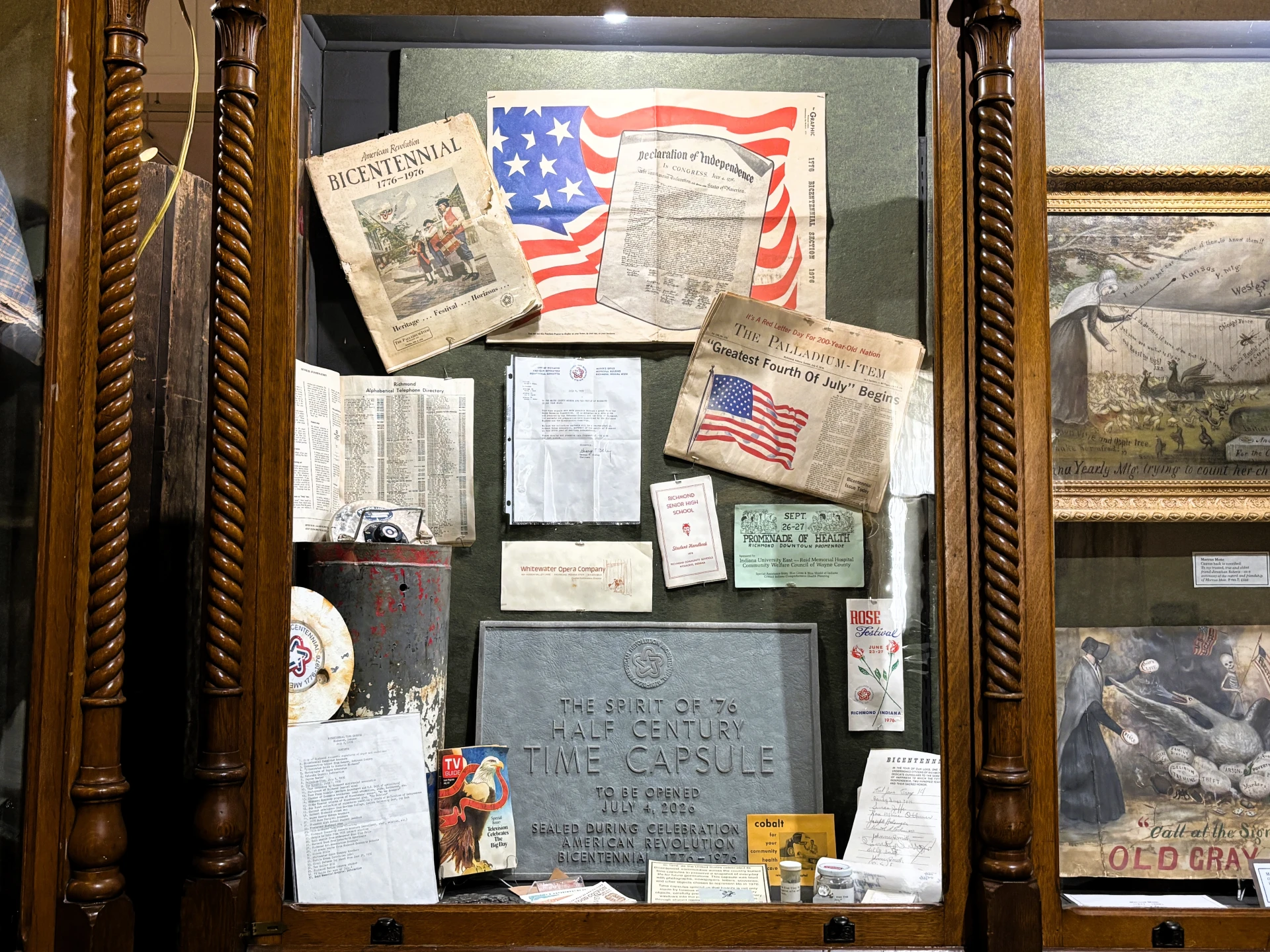
RICHMOND, Ind. – When Richmond buried a time capsule in 1976 to commemorate the nation’s bicentennial, Kerry George, Wayne County Historical Museum Collections Manager, was only three years old.
She didn’t even know the capsule existed until a few weeks before it opened this year.
“Well, I was three when the time capsule originally went into the ground. So, I was a little bit unaware back then. I honestly didn’t even know that we had one until probably three weeks before they opened,” George said.
The capsule, buried for 50 years, contained about 40 items documenting life in Richmond and the surrounding community in 1976. Among the contents were pamphlets and literature from local organizations and businesses, including the Whitewater Opera Company, Reid Hospital and the Rose Festival.
There were also items simply labeled “1976,” including a trivet made by Swain Robinson.
George said the contents were generally what she would expect to find in a time capsule from that era, though some items caught her attention.
“There were a few things in there that kind of surprised me, like the food stamps,” George said.
The TV Guide was a particularly recognizable artifact for George, who remembers using the weekly publication to plan what the family would watch.
“When I was a kid, TV guides came out every week and you bought a TV guide so you knew what was going to be on TV,” she said.
Other objects offered a reminder of just how much technology and daily life have changed in five decades.
The capsule contained a cassette tape, once a common way to listen to music and create mixtapes.
“Now I don’t even have a cassette player here to play that,” George said.
She also pointed to the disappearance of telephone books as another example.
“Who would have thought that we wouldn’t have telephone books, you know?” George said.
Getting into the capsule was itself a challenge. Officials believed they had the combination to the safe containing it, but after 50 years, no one could locate it. George said the capsule had to be taken to Wilson’s Lock and Key to get it drilled open.
“We were very, very lucky in that most of the things that came out of it were still in good condition,” George said.
Richmond’s capsule suffered some water damage, but most of its contents survived.
One of the most interesting discoveries for George was a collection of bicentennial declarations containing hundreds of community signatures. George said she remembers the Rose Festival as a major community event and believes the signatures may have been collected there.
“Everybody went to the Rose Festival. Yeah, that was in the summertime that was just what you did. You know, you spent your time down on the promenade doing all of the activities,” she said.
Several of the artifacts also connected George personally to Richmond's past.
A dried rose from Hill's Roses reminded her of her mother, who worked for the company. Blue clay associated with Blue Clay Falls brought back memories of a place George has enjoyed visiting since childhood.
The Swain Robinson trivet was another reminder of a prominent local employer.
“I don't know anybody my age who doesn't remember Swain Robinson. It's just such a huge factory,” George said.
“We’ve got Western Wayne News, which is good. But you know here we had the Graphic and we had the Palladium. There was another newspaper at the time too and I can’t remember what the name of it was,” she said.
Organizations and traditions represented in the capsule, such as the Whitewater Opera Company and Rose Festival, have also disappeared or changed over time.
“It’s interesting to watch things come and go,” she said.
The capsule’s opening has also made George think about what people in 1976 could, and could not, have imagined about 2026.
“I’m certain that they had no idea at the time in 1976, just exactly how 2026 would be,” she said.
George remembers the 1976 bicentennial celebration as being impossible to miss.
“I remember red, white, and blue, and that’s about it. Everything was red, white, and blue,” she said.
Her brothers graduated from high school that year and even had red, white and blue tassels for the occasion.
“I mean it was everywhere, absolutely everywhere. The people were so excited for it,” she said.
Now, as Richmond looks toward the future, another capsule may be in the works. George said she believes city officials are preparing for another one but does not know when it will be buried or what will be placed inside.
She hopes the historical museum can have some input into what is preserved.
George said she would like a future capsule to continue documenting the community while also reflecting the importance of democracy.
“I would say conservatively that in celebrating the Declaration of Independence and celebrating everything that America stands for, that we need to pay attention to what’s happening in the world and protecting democracy is of the utmost importance,” she said.
For George, that makes the opening of the 1976 capsule somewhat bittersweet.
She hopes the message of preserving democracy is something that can carry from one generation to the next.
“I think that at least I hope, I’m not sure if it’s true, but I hope that people were paying attention that yes, we have this interesting experiment in democracy, and I hope that it gave people a renewed sense of wanting to keep it safe,” George said.
That sense of preserving the past is also central to the Wayne County Historical Museum, where George said both major historical artifacts and everyday objects have value.
“History never stops,” she said. “And so, we are always on the lookout for interesting pieces to tell the story of Wayne County and the surrounding towns.”
George said the museum’s collection spans about 4,000 years and includes everything from ancient artifacts to relatively recent technology that might otherwise be thrown away. Only a small portion can be displayed at any one time, with the remainder kept in storage across its nine buildings.
“We love it if they, you know, they find things in here that are reflections of themselves and so they want to come back,” she said.
That same idea is at the heart of the time capsule: preserving ordinary objects so future generations can understand what everyday life once looked like.
For George, that is what makes opening a 50-year-old time capsule so valuable.
“I think they can continue to do that, you know, a hundred years from now, hundred and fifty years from now. It’s interesting to watch, see how things change.”