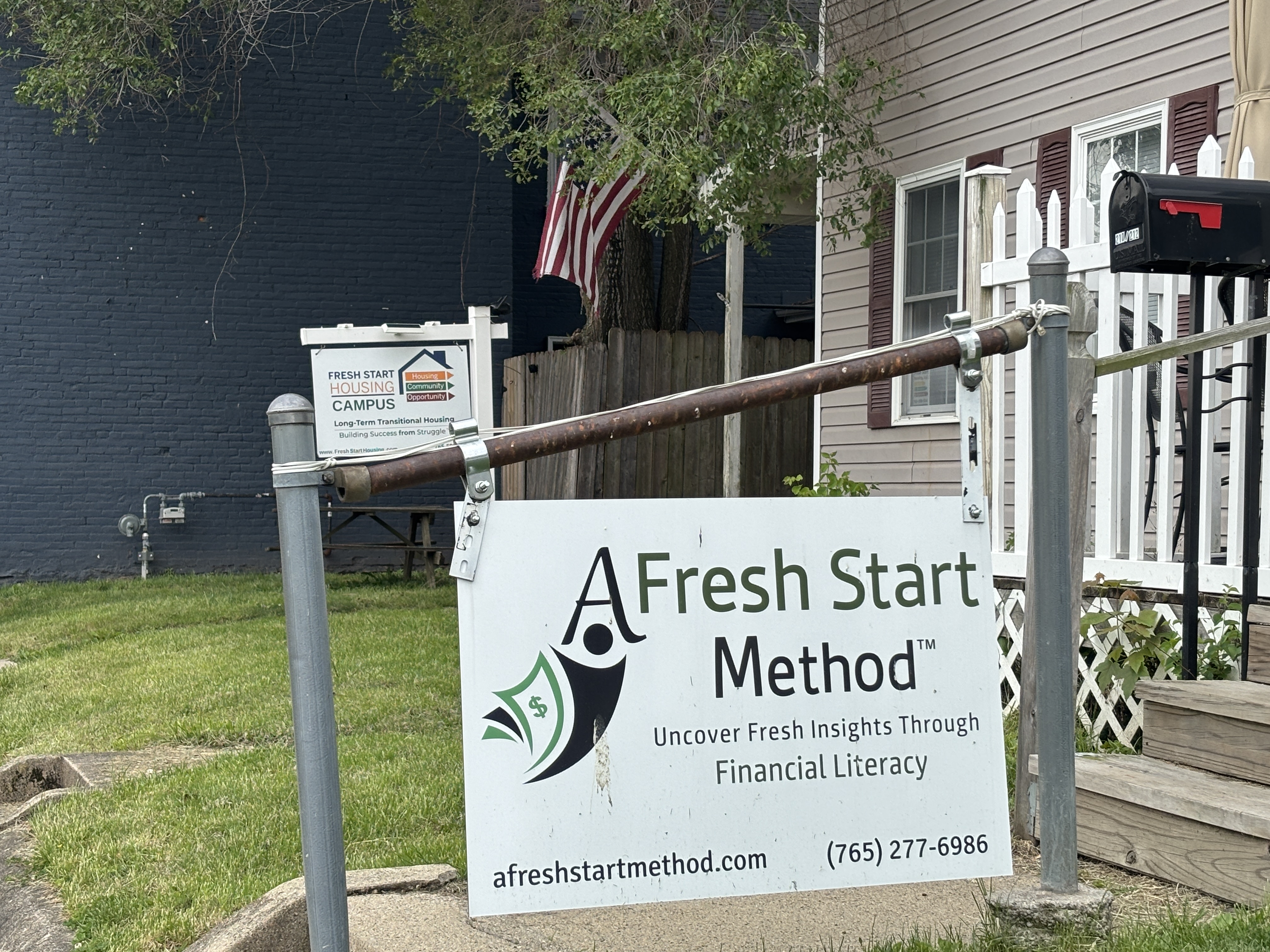
WAYNE COUNTY, Ind. – Fresh Start Housing, a long-term transitional housing program is redefining how support services address homelessness and financial instability.
The program uses a curriculum-driven approach to financial literacy, focusing on behavioral change, education, and what its founder calls “crisis time consciousness.”
Fresh Start Housing operates as a 15-month program, designed to function similarly to an academic trimester system. “This program is 15 months, which is the equivalent of a trimester system in the educational environment,” said Sandra Roussel, CEO and founder of Fresh Start Housing. She added that the model is intentionally designed.
A central component of the program is redefining what financial literacy means beyond basic budgeting skills. The curriculum is a combination of counseling and understanding who they are in relationship to money.
“A lot of people think that budgeting, checking accounts and things like that is financial literacy, which is actually numeracy,” she said.
Instead, she described financial literacy as a more complex system involving behavior, cognition, and environment. “Financial literacy is more complex as it works with individuals’ cognitive abilities, behavioral habits, social connections, and connectivism,” Roussel said.
Roussel emphasized that many participants come from generational poverty or unstable housing situations, requiring a different educational approach than traditional financial planning.
“When they’re in crisis, they think differently,” she said. “Because when you’re in crisis, you’re trying to alleviate the immediate need of your situation.”
Roussel said she does sit-down interviews with people interested in the program, determining that a face-to-face interaction can determine much more than an application with paperwork.
“To speak to somebody and speak to them sincerely as to what they want, and what they want in their life, I can determine whether or not they’ve motivated and they’re ready to transform their life into something more conducive to stability,” said Roussel.
Fresh Start Housing prioritizes immediate shelter before employment or long-term planning. The program is not intended to function as temporary rental assistance or conditional housing.
“That’s why it’s not a rental, because you can’t hold a roof over somebody’s head as a bartering tool,” she said. “That needs to be their safety and their security so that they can go forth and prosper.”
Participants typically begin employment soon after entering the program and attend weekly one-hour curriculum sessions.
Rather than enforcing strict rules, Roussel says the program emphasizes self-awareness, reflection, and minimal direct intervention. She described working with participants to identify behavioral patterns behind financial decisions, including spending habits tied to stress or instability. Participants are expected to take responsibility for their own progress.
“It wasn’t by me telling her what to spend her money on, it was waking her up to her own behavior and her own habits,” Roussel said, describing one participant’s progress. “And never once telling her not to do it.”
Roussel frames the program’s ultimate goal as a shift from survival mode to long-term planning. By the time participants graduate, they’re stabilizing.
“The goal is not living paycheck to paycheck. The goal is actually wealth attainment,” Roussel said. “They’re learning all the rules of how to gain genuine wealth.”
Upon graduation, most save between $5,000 and $13,000.
Beyond housing, Roussel hopes to influence how financial literacy is taught in broader educational systems. She added that traditional education often overlooks students experiencing crisis.
“There is crisis time consciousness in every human being who’s being educated, and it needs to be addressed.”
Roussel also shared that her approach is rooted in personal experiences with homelessness during her youth.
“I myself was homeless from the age of 14 to my early 20s,” she said.
She credited that experience with shaping her ability to understand participants’ behavior and needs. After more than 17 years, Roussel estimates that she has worked with over 400 individuals through the program.
When asked about the broader takeaway from her work, Roussel pointed to judgement and empathy, also adding that individuals should not place interpretations on the choices of others in crisis situations.
“You can’t judge,” she said. “You shouldn’t judge. You really shouldn’t.”